
Getting traffic is only half the battle
You’re getting traffic? T’riffic! This shows your blog is working as it should be and there are no hidden technical issues to worry about.
But unless that traffic is turning into leads — and, ultimately, sales — your blog isn’t generating the leads your business needs and you need to look at your strategy.
A good place to start is understanding your ideal customers and their journey. Every piece of content you create should be aimed at your ideal customers at different stages of this journey.
Understanding the customer journey
This is an overview of the customer journey, from the time a prospect becomes aware they have a problem to the time they make a purchase and then eventually become an advocate for your brand.
It’s an idealistic representation of the journey that doesn’t include meltdowns, dithering and general customer messiness. But it does highlight the key stages where there are opportunities to create helpful content.
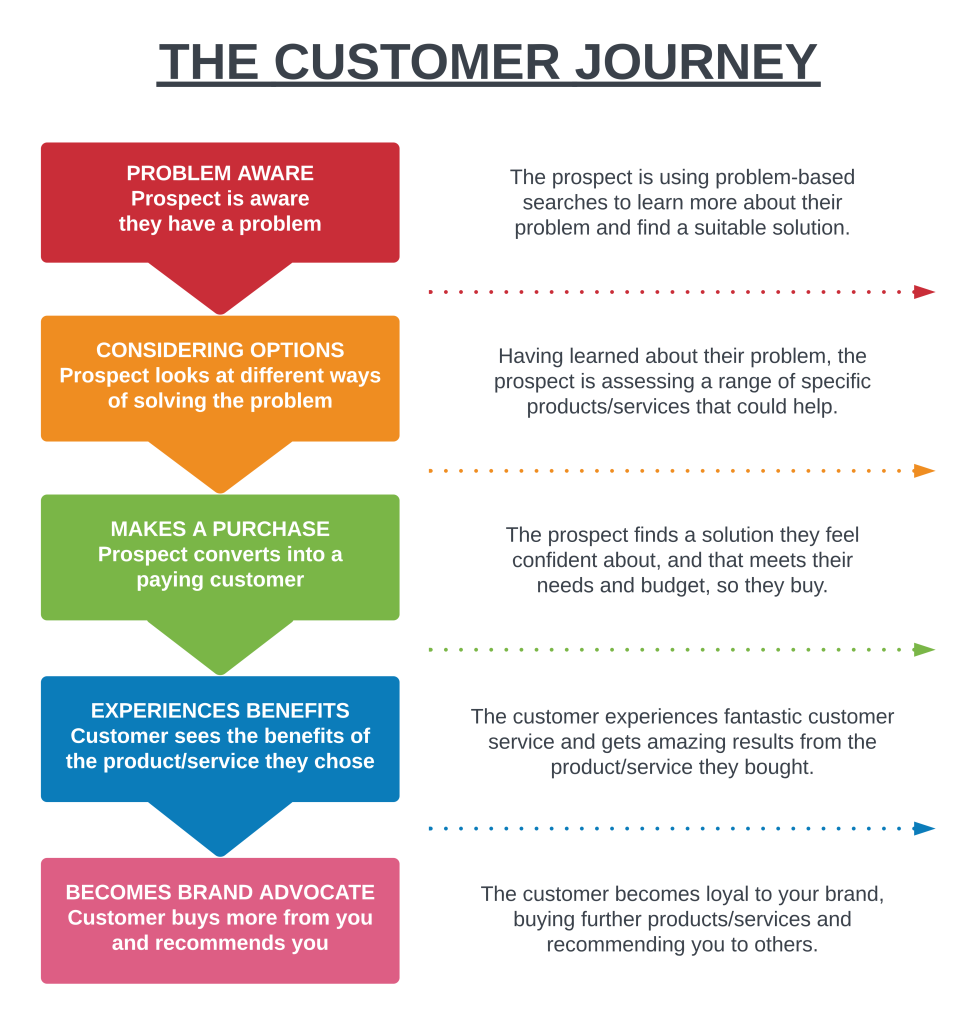
Now you can see the basic customer journey your prospects are taking, let’s move on to the reasons your blog might not be generating leads.
Why your blog is getting traffic but no leads
You’re working without a content strategy
You didn’t start your blog with any kind of strategy, so you’ve been randomly creating content and hoping something sticks.

A content strategy helps you create the kind of content your prospects want to see and are actively searching for online. This will bring them to your website where you can show them your expertise, build their trust and convince them why what you’re offering is right for them — or not.
What your content strategy should cover
Your strategy should cover things like your:
- Aims and objectives
- Themes and topics
- Target audiences
- Internal linking
- SEO keywords.
An effective strategy will help you create content that satisfies your visitors’ needs and the goals of your business, so you’re both getting the value you’re looking for.
You’re optimising for traffic rather than people
You’ve optimised your blog to draw maximum traffic, using topics and keywords that are broad and popular. But somewhere along the way, you’ve forgotten that traffic = people.
When you optimise for traffic volume, you’re inevitably going to attract people who are interested in your topic, but who don’t need what you’re selling and are never going to buy from you. This is why high numbers of visitors doesn’t always result in high numbers of leads.
Switch to a people-focused approach
You need to stop thinking about traffic numbers and start thinking about people.
Here’s how to switch your thinking from a traffic-focused approach to a people-focused approach.
Traffic-focused approach
How much traffic did we get?
Which keywords get the most clicks?
How can we increase our page views?
How long are people staying?
How can we rank higher?
How do we convert more leads?
People-focused approach
How many relevant visits did we get?
Which searches are for a problem we can solve?
How do we help our visitors to progress?
Are people getting what they need from us?
How do we become the right choice?
What’s stopping the right people from enquiring?
Think about why people are coming to your blog and what they want to see when they arrive. Are you delivering for them and giving them what they need? If not, why not and how can you change that?
You’re not “listening” to your audience

When you’re deciding what to write about, you’re making assumptions about what your audience needs or asking AI. This approach will be hit and miss at best.
To understand what your audience is really interested in, you need to “listen” and learn.
How to “listen” to your prospects
You can listen to the prospects who contact you and ask you questions. You can also research what your ideal customers are asking, talking about and looking up online.
For example, you might look at:
- What problems they’re having
- What questions they’re asking Google
- What information/ideas they’re searching for.
By actively “listening” to what your audience wants, you can create better content for them so they’re more likely to feel understood, to engage with your brand, and, eventually, convert into customers.
You’re not targeting the right audience

You’ve been writing content that feels relevant, but without really thinking about who’s going to read it or benefit from it. And, as a result, it’s been kinda missing the mark.
If your content isn’t targeted, with a specific audience and message, it won’t reach the right people, it won’t speak to the right people, and it definitely won’t convert the right people.
How to target your content
For every piece of content you create you should ask and answer the following questions:
- Who do you want to reach?
- Where are they in your customer journey?
- How are you going to reach them?
- How are you going to help them?
- What conversion do you want to achieve?
Here are some example answers to those questions:
- People who need IT support
- Problem aware — they know they have a problem
- SEO keywords that describe the problem they’re having
- Show them their options for fixing their issue
- Get them to sign up to your mailing list.
Targeting your content for conversions
To get the maximum number of conversions from your content, you should be writing content for people at all stages of your customer journey. From those who’ve just realised they have a problem, to the brand advocates who already choose you and buy from you consistently.
With a proper plan in place, you should start getting the conversions you want.
You’re using your blog as a sales tool

Then why the hell isn’t it selling, goddammit?!
Because the main job of a blog isn’t selling, it’s to help your prospects buy. And that’s an important distinction.
When people seek out content, it’s usually because they’re at the stage of the customer journey where they’re weighing up their options. What they need is objective information and impartial advice that will help them make an informed decision. What they don’t need is a sales pitch.
If your content is too salesy, your visitors won’t feel able to trust it.
Why should your content be impartial?
Giving visitors the right information helps them find the best solution to their problem. Something that will work well for them and satisfy their needs at the price they want to pay.
That might not always be your solution, but that’s okay, because if your solution isn’t right for them, they’re probably not your ideal customer at this point in time. Selling the wrong things to the wrong people can invite negative feedback, which you definitely don’t want.
Being impartial and giving the best advice is an excellent way to build trust. So even if you don’t convert this person this time, you will have given them a positive experience they’ll remember. And, as a result of that, they may come back to you in time.
You’re not promoting your business as the ideal solution
You’re answering your prospects’ questions and addressing their concerns. But you’re not then promoting what you can offer them as the solution to their problem. As a result, they’re getting their answers and leaving, because there’s no reason for them to stay.
Before you write each article, you need to ask yourself two questions:
- Is this something my ideal customers are searching for?
- What’s in it for me and how will it achieve my goals?
Include a CTA in your articles
The aim should always be to give something and to get something, so make sure every post includes a relevant call to action (CTA) at the end. This will give your readers somewhere else to go.
For example, that might be to:
- Another relevant article
- A page of your main website
- A page offering a lead magnet to download
- A sign-up box to subscribe to your mailing list.
Using CTAs like these will give you more opportunities to convert a new customer.
Your CTAs aren’t compelling enough
The CTAs you use in your article need to be irresistible enough to inspire your reader to act. If they’re not, that could be impacting your conversions.
Sow how do you make your CTA more compelling?
Turn your CTA into a CTV
A CTV, or call to value, prompts your readers to take action and shows them why they should take that action.
For example:
CTA: Sign up to our mailing list
CTV: Never be stuck for ideas again! Sign up to our mailing list and get daily content prompts.
CTA: Read our article on knitting
CTV: Get inspired, with dozens of cosy creations you can make at home.
CTA: Visit our sales page
CTV: See our stand mixer in action and learn how to get amazing results every time.
Your content rambles
Your articles start with a long and largely unnecessary introduction. Then they ramble on, line after line, without any line breaks. Long sentences that take ages to get to the point and occasionally wander off on tangents like they’re out for a Sunday stroll.
But your readers just want the answers and information they came for, delivered directly and succinctly, in a way that’s easy to consume. If your content makes it difficult for them, they’ll just go elsewhere and, eventually, spend their money there instead.
Deliver valuable and consumable content
To make your content valuable and consumable:
- Keep your intro brief and get straight to the good stuff
- Use short paragraphs with white space between them
- Introduce each section with a relevant heading
- Vary the lengths of your sentences
- Maintain a linear structure that doesn’t veer off topic
- Aim to say something significant in every sentence.
Your content is poor quality
Poor quality content doesn’t inspire confidence. And if people don’t feel confident about your brand, it’s unlikely they’ll want to spend their money with you.
What do I mean by poor quality?
Here are some examples:
- Content that lacks detail and substance
- Spelling mistakes and grammatical errors
- Making bold claims without giving any evidence
- Citing sources that aren’t current or credible
- Using AI without bothering to edit or fact-check it
- Not delivering what your headline promises.
Improve the quality of your content
For content that’s more likely to convert, make sure you’re:
- Producing articles that are well-written, valuable and interesting
- Doing the necessary spell-checks, editing and fact-checking
- Researching your content well and crediting the original sources of your information
- Formatting your content so it’s easy to skim-read and find information
- Optimising your articles for Google, but writing for your human audience.
Your conversion method has issues
It might not be your blog or content that’s causing the problem. It could be where you’re sending your readers next.
For example, if your:
- Onward link is broken and goes to an error 404 page
- Enquiry form is too long and convoluted, or asks for too much information
- Lead magnet isn’t downloading or isn’t doing its job to convert them
- Contact form or ordering process is broken and not completing.
Check your processes regularly
Use a broken link checker on your site regularly and fix any broken links it finds.
Make a point of testing your processes once a week to make sure they’re working and not letting you down.
Listen to feedback on things like enquiry forms and ordering processes. Are they too long? Too convoluted? Too nosey? Too many hoops to jump through? Respond to feedback like this by making improvements.
Need some help creating content that converts?
Understanding the theory behind creating great content is one thing, but actually doing it is entirely another. This is why many businesses with successful, high-converting blogs use professional content writers.
I’m Jenny Lucas an SEO content writer based in Leicester, UK.
I’ve been writing content that attracts and converts for more than 17 years — and I could write for your business, too.
- With a proven SEO strategy that works to attract the right kind of visitors
- With a sound content strategy that targets people at every stage of your customer journey
- With well-researched, well-written content that informs, inspires and entertains.
If that sounds like the kind of help you need:
- Visit my content writing page for more information and pricing
- Get in touch to discuss your needs.

You might also like…