


Is your website losing traffic?
You have a blog that’s been working well to drive organic traffic to your website.
But, lately, you’ve been noticing a drop in your traffic and your click-through rate (CTR) is down. So what could be the problem?
The same thing happened to a business I know.
Here’s what happened.
This is a true story
A business had a top 10 tips article on their blog and it was one of their most visited webpages.
The tips were valuable, the SEO was on-point, the traffic was excellent. But the article could have been ranking and converting better, so the business made some improvements. They kept the existing listicle format, but added more SEO keywords and focused more on how their business could help visitors.
At first, it seemed the changes had been successful. The article’s impressions grew, as expected, and it climbed up the rankings, as expected — but its click-through rate fell off a cliff. Ouch!
What went wrong?
As the business published their improved article, Google was introducing the latest version of its new AI summary.
The new AI summary was programmed to pull together bite-size information in a list format. The business’s article contained bite-size information in a list format.
Can you see where I’m going with this?
Google’s AI was taking information from the business’s article to use in its summary. And because people were reading the information in the summary, they had no reason to click on the article.
Effectively the AI summary was stealing the business’s clicks. Rude.
This is something that’s becoming more prevalent and, as a website owner, you need to be aware of it.
It’s an example of commodity content
The business’s top 10 tips article was a classic example of what we’re now calling commodity content.
In economics, a commodity is something that’s basically the same product, no matter who produces it. Like sugar, oil and steel. The buyer cares less about the product and more about the price, convenience and availability.
What is commodity content?
Commodity content is generic and easily copied. The reader cares less about who created it and more about how easy it is to find and consume.
It’s the kind of content AI will strip for parts — taking all the good stuff for itself and leaving you with a husk of an article that does nothing for your business.

Commodity content is content that’s:
- Generic and kinda meh
- Been done to death
- Not introducing anything new or different
- Not bringing any original insight, opinions or perspectives
- Compiled using publicly available information, anyone can find.
Examples of commodity content
Commodity content includes:
- Generic listicles
- Basic how-to guides
- What is… ? explainer articles
- Generic buyer guides.
AI isn’t totally heartless. It will credit your blog article as its source and give a link to it. But when your article is titled ‘10 tips’ and the AI summary is giving 10 tips, it’s already stolen your thunder.
Businesses should be creating non-commodity content
Non-commodity content is the opposite of commodity content. It’s fresh, unique, and authentic to you, which makes it more valuable and more difficult to replicate.

When it’s non-commodity content, readers do care about who creates it. They care that it’s real and comes from a place of first-hand knowledge and experience. This is the kind of content they feel invested in and they want to know they can trust it.
Non-commodity content contains material like:
- Storytelling
- Lived experience
- First-hand research
- Original imagery or photography
- First-hand knowledge and expertise
- Unique perspectives and opinions.
Examples of non-commodity content
Non-commodity content includes:
- Real-life stories
- Research studies
- Expert opinion pieces
- In-depth case studies
- First-hand interviews
- Original infographics
- Independent experiments
- Unique inspiration guides
- Evidence-based forecasting.
Non-commodity content is a natural next step in blogging
Google has been pushing us towards creating more unique, non-commodity content for several years now.
Its Quality Rater Guidelines have rewarded content that features Experience, Expertise, Authoritativeness, and Trustworthiness (E-E-A-T). And its Helpful Content updates have penalised commodity content created by content spinning and mass-producing AI articles without any human oversight.
So, although content writers weren’t able to predict exactly what AI search would look like, we were prepared enough to start adding that extra uniqueness and value to the articles we wrote.
How to get your blog back on track
If you think your blog has a commodity content issue, this is something I can help you rectify.
Have a professional content audit
A content audit is like a health check for your blog.
It’s a review of the articles you have on your blog to assess their quality, relevance and performance. This will tell you if an article is fighting fit, if it needs reviving, or if it needs killing with fire.
Spoiler alert: most content contains some value — even your commodity content — so never write anything off straight away.
When I audit your content, I’ll start by creating a spreadsheet inventory of your articles and how they’re performing. I’ll then produce an action plan that details what needs to be done to update and improve your blog. This will include transforming commodity content into non-commodity content.
You can read more about my content audit service here:
6 Good reasons your blog needs a professional content audit >>
Content auditing to make your blog work harder for your business >>
Revisit articles with problematic titles
Some article titles are problematic because they appear to give it all away.
For example:
- 10 Top tips for contouring —> AI summarises the 10 tips
- How to boil an egg —> AI gives instructions on how to boil an egg
- What is matcha? —> AI explains what matcha is.
If people can get what your title promises from the AI summary, they’re not going to bother reading your article — even if your article includes way more value than the title suggests.
Your title needs to tease something more valuable — and your article needs to deliver it.
For example:
- Contouring secrets from a professional make-up artist
- A chef’s guide to cooking eggs with perfect runny yolks every time
- Mind-blowing matcha flavour combinations we created in our kitchen.
Refresh, rewrite or repurpose older articles
Yes, okay, I shamelessly stole this idea from Reduce, Reuse, Recycle, but it works in a similar way.
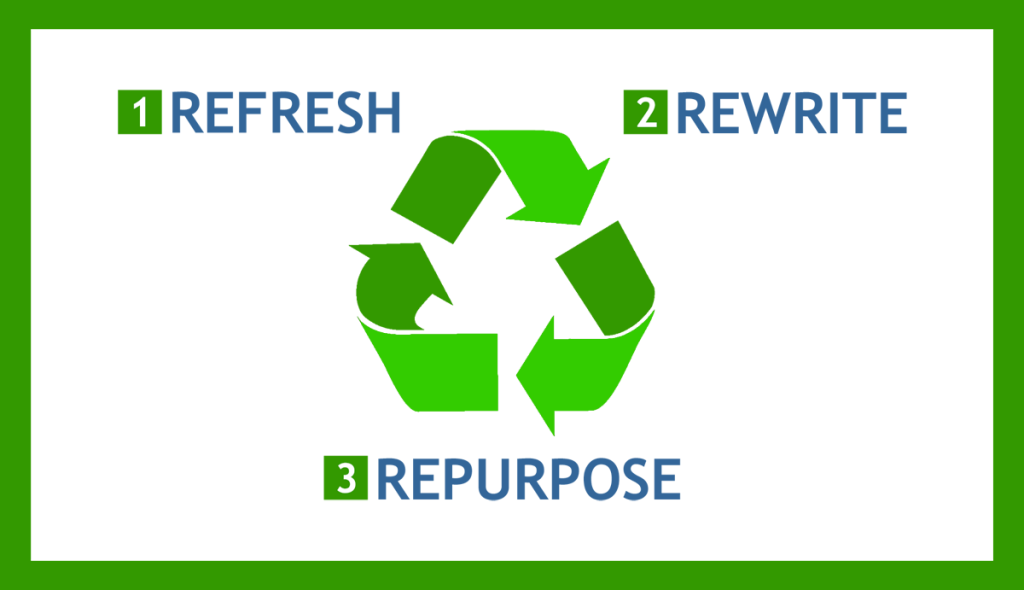
I have a make-do and mend mentality, in life and in work, which means I make every effort to fix things before I throw them away.
Rather than simply deleting older articles that are no longer serving their purpose, I’ll look for ways to sharpen them up. Some older articles are still valid, but need refreshing with the latest information or better SEO keywords. Some could benefit from a rewrite. Some might have passed their use-by date, but the information or ideas could be repurposed.
You can read more about how Refresh, Rewrite, Repurpose works, here:
Refresh, Rewrite, Repurpose: how to audit and reuse your old blog posts >>
Add as much value as only you can
Your articles will be more unique and valuable to you if they include your input.
That could be in the form of your:
- Real-life stories
- Insight and experience
- Knowledge and expertise
- Perspective and personality.
When I rewrite articles for you, I’ll always prompt you to add your own twist.
This is how to turn generic commodity content into non-commodity content that showcases your Experience, Expertise, Authoritativeness and Trustworthiness (E-E-A-T). And it should help stop that pesky AI from stealing your clicks.
Need some help to stop AI stealing your content?
As a human copy and content writer, nothing irks me more than the AI takeover of our glorious internet. And if there’s any small thing I can do to stop it, I’m there.
That includes helping businesses, like yours, from losing potentially valuable clicks and traffic.
Work with me and I’ll:
- Audit your blog to highlight commodity content, poor performance and other issues
- Create an action plan that outlines how to fix them
- Do the work to bring those articles up to standard
- Give you the prompts you need so we can add your own spin
- Develop a better strategy for writing non-commodity articles in future.
If this sounds good and you’d like my help, get in touch and send me the link to your blog.

You might also like…