


So you have a blog for your business?
That’s cool.
But you may have discovered, having a blog and knowing what to write on it are two vastly different things.
And maybe that’s how you’ve ended up here.
But worry not. I’m a pro who’s been writing blog posts for the last 16+ years and I’m going to walk you through everything you need to know about what to write on a blog. Starting with an explanation of how your blog should work, because that’s the first thing you need to understand.
What a blog should do for your business
Your blog content should perform a number of important functions for your business. It’s important to know these as they’ll help you understand what to write.
Let’s look at five of the main ones.
Generate inbound leads
Blogging is a form of inbound marketing, which means it brings your ideal customers to you.
Using SEO keyword research, you work out what your ideal customers are searching for online, then you create content that satisfies their search queries to draw them into your lair — I mean, website.
In practice, that works something like this:
- Your ideal customer has a question or need and does an online search
- The online search brings up some results, which include your post
- Your ideal customer clicks on through to your post to read it
- While they’re on your site, you engage them further.
Engage your audience
When your ideal customers arrive on your site, that’s your opportunity to engage them.
First, make sure the content they came to see gives them value they’re expecting. If it feels clickbaity or leaves them disappointed, they may not engage further with your brand.
Second, look for appropriate ways to engage them further by adding calls to action (CTAs) in your content.
For example, that might be:
- Links to other blog posts that might be of interest
- A link to sign up for marketing emails
- A valuable lead magnet to download
- A limited time offer or discount
- A free trial of your product.
Build your brand
Creating organic content is one of the best ways to build a brand.
It enables you to:
- Demonstrate your experience and expertise
- Build trust and authority in your sector
- Show your personality and approach
- Provide updates and announcements.
Provide an information repository
Your main web pages should be laser-focused on converting the people who have done their research and are ready to buy. Clogging them up with basic information will just make your prospects lose interest and dilute your sales message.
Your blog is where you should be educating the leads who are still doing their research and still have questions. It’s also a good place to answer some of the practical questions your prospects might have about working with you.
Creating links from your main-page content to your blog content will help to tie everything together.
How your blog should be structured
Your blog should make it easy for visitors to find what they want to read, so it’s best to divide your posts into categories. Content creators call these your content pillars.
Having content pillars in place makes it easier to plan content that’s appropriate for your brand and targeted for your audience. And it helps prevent you from going rogue and writing on subjects that aren’t useful or relevant.
Technically, you can have as many content pillars as your platform will allow. But, as a rule, 8-10 is a good and manageable number. You can plan your categories in advance, but you’ll usually introduce each new category as you add articles to it.
How to attract your ideal customers
To draw your ideal customers to your website, you should be writing the kind of blog content your audience is actively looking for when they search online. This is how they’ll find you.
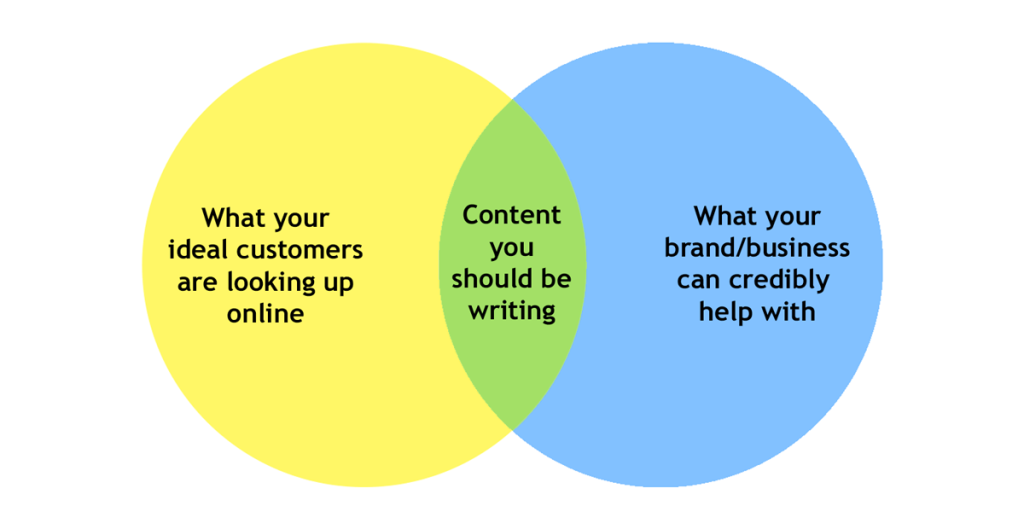
The Venn diagram below explains this simply.
The content you should be writing is in the sweet spot between what your ideal customers are looking up online and what your brand/business can credibly help with.
But how do you know what your ideal customers are looking for?
Here are some things to think about.
What questions are your ideal customers asking?
Your ideal customers have questions and you have the answers.

What are the questions your leads, prospects or customers often ask you? This could give you some clues about the kinds of questions people are asking when they open a search engine or log into AI.
Providing the answers to these questions
Some people will have their questions answered by the AI summary and won’t feel the need to search beyond that. What you should be aiming for is the people who want more. If you make sure your article gives more value than the AI summary, this will give them somewhere else to go.
What information do your ideal customers need?
Your ideal customers need information and you have that information.

People who need information will be doing searches with informational intent.
For example:
- Pros and cons of electric cars
- How to plan a household budget
- Ways to save time and work faster
- Renting vs buying
- Ideas for a more balanced diet.
Giving them the information they’re searching for is helping them build the knowledge they need to make a decision. If you do this well, they’ll come to see you as a trusted expert, consuming more of your content and knowing who to turn to when they finally make their decision.
What do your ideal customers need explaining?
Your ideal customers want to understand something and you can explain it to them.
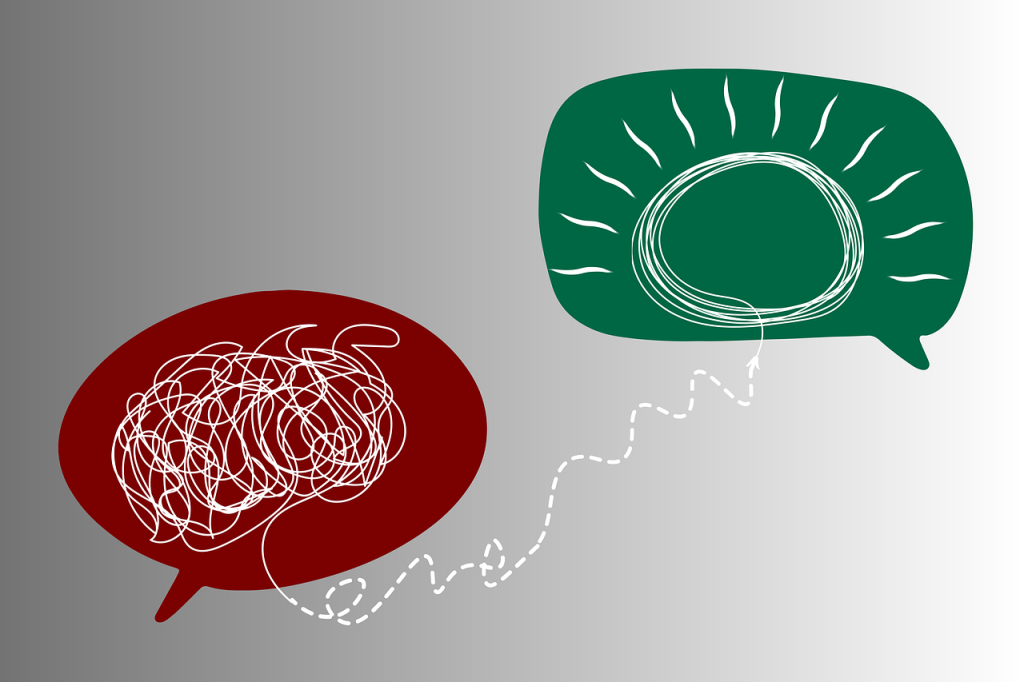
This is called explainer content and it helps ideal customers who might feel lost or confused get the clarity they need.
Examples of explainer content might include:
- A glossary to explain unfamiliar terminology
- A simplified version of something complex
- A dissection of how something is made
- A breakdown of how a process works.
Explainer content will help to keep your audience engaged and in the loop. And it will show that you understand them, what they need to know, and how they need it explained to them.
What ideas do your ideal customers need?
Your ideal customers need ideas and inspiration — and that’s where you come in.

People need ideas for all kinds of things.
For example:
- Where to go on holiday
- How to decorate their kitchen
- What to wear for a job interview
- How to plan a child’s birthday party
- What to write on a blog — see what I did there?
If you have related products or services, you can introduce these along with the other ideas you’re putting forward.
What problems are your ideal customers having?
Your ideal customers are having problems and you have the solutions.

People with problems will be doing problem-based searches.
For example:
- How to extend my laptop battery life
- Best way to remove mould from my shower
- Reasons why my website traffic is dropping
- Proven ways to stop procrastinating
- How to improve sleep without medication.
To attract these people, you need to write content that gives them solutions. Not just your solution — because that would be a sales pitch rather than a piece of content — but you can include your solution among the other options. And if your solution is the best one for that person, you might even make a sale.
What kind of brand are your ideal customers looking for?
Your ideal customers are specifically looking for a brand that shares their values or vision — and that brand is yours.
This is where brand-based content can help you.
For example, with content that talks about your:
- Green values and commitment to sustainability
- Career opportunities for disadvantaged people
- Future plans, ideas and innovations
- Ethics and fairness.
Additional content
Some so-called experts put all their eggs in the SEO basket. They’ll tell you anything that doesn’t rank is useless and should be deleted.
As a content strategist, I disagree. Because there’s value in writing content for other audiences. Like the people who are already on your website and your existing customers. This kind of content can be informative for them and save you time, so it’s still working for your business, but in a slightly different way.
Here are some things you might think about writing for your other audiences.
Giving specific information
When your ideal customer is on your website, they may want more information that only applies to you or your brand. This might be information you can’t optimise for, but is still necessary.
For example this kind of content can:
- Answer common questions, specific to you
- Explore your process approach and style
- Talk about your terms and pricing.
Addressing specific concerns
Some of your ideal customers will have specific concerns about working with, or buying from, you. Writing content that addresses these concerns will help them make the right decision, whether that’s a yes or a no. And it will help filter out any bad-fit customers you don’t want to work with.
For example, you might include content that:
- Addresses common concerns they might have
- Provides transparency and manages expectations
- Explains whether you’re a good fit for their needs.
Guiding your customers
Ideal customers who’ve become paying customers can still have questions and need further support.
You might choose not to have this content on your blog. But, if you do, it can give your ideal customers more insight into what it’s like to work with you.
For your existing customers, you might write content that:
- Outlines how to get the best results with you
- Guides them through parts of your process
- Explains the terminology you’re using.
Final thoughts
The people who read your content want two main things from you:
Write content that satisfies them
I’m talking genuinely valuable content that matches their search intent, satisfies their needs and, if possible, exceeds their expectations. Because anything else is just clickbait — and nobody likes clickbait.
Write content that’s objective
Remember, people have come to read a piece of content — not a sales pitch.
Your content needs to be objective and useful, with expert answers, information, and ideas. The goal is to help your ideal customers understand what’s best for them and make an informed decision.
That might be your product or service, or it might be something else. The best content gives them the information and empowers them to make a free choice.
Do you need content ideas for your blog?
Maybe I can help.
I’m Jenny Lucas, a content strategist with more than 16 years’ experience of writing content that ranks and converts website visitors into customers.
I’ve refined my content services to provide just the support you need. From strategy, ideas and SEO to a fully done-for-you package that includes everything you need for successful blogging.
To find out more:
Learn about my content services >>

You might also like…